
JOANNE HILLHOUSE REVIEWS 40 DAYZ BY MOTION

Artist Draws On Caribbean Roots

By Joanne C Hillhouse – Thursday, November 19th, 2009.

A self-described daughter of the Diaspora, Motion’s writing has a creole personality. That is, it is its own thing but informed by the mixture that helped create it; kind of like a pepperpot – and like the pepperpot, very satisfying. Her first collection Motion in Poetry and the accompanying Audio Xperience remain my favourite of her published works, but the leaner 40 Dayz has its merits. It’s like a hit to the funny bone, there’s nothing funny about it, but it lingers.

In fact, the very title 40 Dayz immediately suggests trial and temptation, recalling as it does a particular biblical 40 days and 40 nights of testing. My favourite section is WombStory and my favourite poem, I think – this changes – blues. Like the blues themselves, it sings of one thing while seeming to sing of another and does so in a tone at once mournful and yearning. My favourite line: “I was wood in wanting/lips opened/but no sound would come/unless you played me.”

There has always been in Motion’s writing an ownership of words – and a willingness to bend them to her will, a fearlessness when it comes to digging around in uncomfortable emotional spaces, and an acknowledgment of the power of her voice. That is even more so here.

Aesthetically, meanwhile, underneath her northern urban sensibility, there’s that blend of her Caribbean – ie Barbadian and Antiguan – roots. “Hearing Short Shirt on the record player in Toronto, spending summers with my grandparents in Bolans, playing steel pan at Caribana, playing Mas’ at Carnival, these are part of the experiences that live within me,” Motion acknowledges.

In 40 Dayz, the images flicker in and out, sharp and precise but almost too quick to grasp; in my case a few readings were required for it all to begin to sink in. In the end, I found a collection that startles and questions – no, demands – as it pushes and prods at things.

In the New Orleans inspired, and the rains came, Motion writes,
“what happens when rivers retreat/and remains rain downstream/the smell of defeat”.

In hedlines, a poem that appealed to the CNN junkie and fellow traveller wandering at the state of things in me, she writes “a poet is detained/a woman births the baby of a/soldier who crouched in the bush/on the stroke of now/small arms heave rocks … machines begin their ruthless grind/nite is quiet/I can’t sleep.”

In wombstory, she laments, “ghosts live in my womb” and she records their passing; “limbs reach for feeling/clench fists when hoses/seek them/mouth opened in no/and there soft/malleable bodies go.”

And in why, of desperate acts, she asks, “did you get tired of getting by?”

In this collection, there is the burn of racism and the pain of letting go; an arduous labour through personal and societal torment. But it ends on a hopeful note, not in the way of fairy tales but in a way that those who struggle and come out on the other side know only too well. This section, epiphany has only two poems. To quote one question/answer/period in full “will there ever be another revolution/will there be another revolution/will there be a revolution/will there be revolution/will be revolution/will revolution/be revolution.” It is a good example of how simultaneously spare and sharp the words are in this collection, and of the way this writer twists every last bit of meaning from the coming together of consonant, vowel, and sound.

It’s a craft Motion has perfected since her days recording made up songs into a tape recorder and writing in the red diary given to her seven-year-old self by her mom with the charge to write in it every day. Since then, she’s blossomed as award nominated hip hop artist, radio personality, and acclaimed Toronto-based poet – her Connect the T.Dots garnering her top billing, in 2002, at the CBC National Poetry Face-Off.

I heard Motion perform before I ever read her on the page, and always thought the impact of that accounts for the fact that her voice infuses every line. But now, I’m prompted to think it has to do with how the lines come to be, in her own words “flowing lyrics, off the top of the head into a mic, free-writing onto a page, and seizing those moments of inspiration that start with an image or line, and leads to a poem.” They are meant to be heard, I think, and so jump up and announce themselves rather than lying on the page.

Motion, who first performed here a year ago at the Antigua & Barbuda International Literary Festival, hopes to continue introducing herself to the place where her family’s navel string is buried. “My vision is to collaborate with Antiguan writers and musicians,” she said. “I would love to do more readings and performances in Antigua. I definitely would visit schools, present creative writing workshops for youth and emerging writers.” Meanwhile, wordsmiths and lovers of the word alike can pick up 40 Dayz and Motion in Poetry at Best of Books or online.


Posted in Press | Comments Off on JOANNE HILLHOUSE REVIEWS 40 DAYZ BY MOTION

MOTION LAUNCHES 40 DAYZ – THE VARSITY

Poetry In Motion

Rising Torontonian poet Motion’s unique performance combines elements of hip-hop, soul, and spoken word

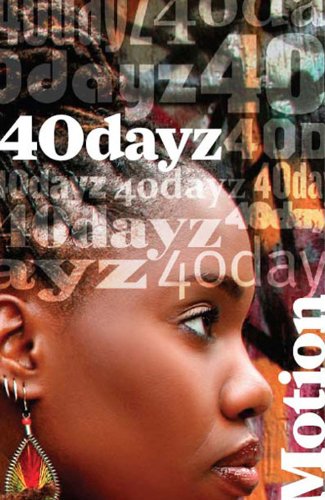
Toronto-based writer, hip-hop artist, and spoken-word poet Motion graced the stage at Trane Studio last week to launch her new book of poetry 40dayz.

Motion describes her unique style of spoken-word as an interactive mode of expression that combines preaching, storytelling, public speaking, and the vocalization of poetry. She fused her poetry with elements of hip-hop, jazz, soul, and Caribbean music, creating a unique and captivating performance.

Motion’s undeniable stage presence and ability to connect with a crowd was evident as she rapped, sang, and recited a selection of her poems from 40dayz. A perfect complement was her full backing band, comprised of bass, drums, trumpet, and DJ L’oqenz, a staple throughout the set.

“I want to keep incorporating new instruments,” said Motion, in a recent interview with The Varsity. “I love wind instruments and string instruments. Also, I want to keep building production—and I can’t forget DJ L’oqenz, because DJs are musicians too. So I’m open to a whole bunch of different ways to do music, from live to digital, to manipulating sounds, to sampling.”

In addition to her band, Motion was backed by three female vocalists, each of whom was selected to contribute to the tone of her work. Motion has performed with her musicians and singers for years, and she went to high school with most of them. “Almost everyone who performed with me that night I’ve known in some artistic capacity for a while. [Bluesy singer] Michelle Francis and I had a band in high school, so it was great to bring those people together. It was like a family affair, and I was very happy for the support and the opportunity to collaborate and bring this vision to reality.”

A graduate of U of T in English and African Studies, Motion was exposed to an array of music from an early age. “My mother was always saying I could dance before I could walk. I’ve always loved music, I’ve always loved dancing. I loved expressing myself to an audience—singing, making up songs, writing.”

With parents from Antigua and Barbados, her exposure to Caribbean music, soul, reggae and jazz was unlimited—it included such artists as Bob Marley, Roberta Flack, Sparrow, Isaac Hayes, and Parliament Funkadelic. These eclectic influences and her resulting musical vision are apparent in her arrangements. “Sometimes I [write the arrangements myself], but I also have input: I work with people to build instrumentation, but I’m definitely expanding myself into the production side. I surround myself with DJs and producers who give me input into production aspects…because I love music and I have a good sense of what I want to hear underneath my lyrics.”

Whereas her first book, Motion in Poetry, was comprised of poems written throughout her life, the material in 40dayz came together over the course of a year.

“It was almost 10 years of writing that I had to choose from for Motion in Poetry. It’s very lyrical, it has a lot of attitude, but it also has peaks and valleys where it moves from reflection to straight-up affirmation to exploring the whole concept of relationships and romance. [The first book] was sort of like my introduction as an emerging woman, and I think that with 40dayz it was [my] focus on a particular theme that opened my eyes to new things, to new stages of my own artistry and my own life.”

As she began to craft 40dayz, Motion was influenced by her experience at the University of Guelph’s Fine Arts program, where she had the chance to work with esteemed poets Dionne Brand, Judith Thomson, Tom Kane, and David Young. Motion credits Brand in particular for exposing her to contemporary poets with whom she was unfamiliar.

“I started thinking about how 40 days is often associated with trials and tribulations, going through your challenges and being able to go through that fire and emerge scathed but stronger. I think that’s just reflective of life. It was a way of documenting a season that I’ve been through.”

In addition to this theme of resilience, Motion has focused on different kinds of poetry. Not all of her poems are free verse—there’s some haiku as well. She found herself compelled to place restrictions on her creativity, limiting herself to a certain number of lines or specific structure, to make the words as potent as possible. “I really admire Langston Hughes, the poet from the Harlem Renaissance. I was fascinated by the way he could use four lines and just blow you away, how he could say so much with so little. That was something I had in my mind [while writing this book].”

One poem in particular which stood out at the book launch was “Connecting The T-dots.” This work won the CBC National Poetry Face-Off, where a poet is chosen to represent each of Canada’s major cities, and listeners vote to pick the winner.

“The theme that year was ‘love in your city’ and when I heard that theme I thought, ‘Wow, there’s so many ways I can approach this,’ because when we hear the word ‘love’ we always think of walking hand in hand, flowers, kissing and candy…but I wanted to explore love from the urban cities that I’ve seen, its good and bad aspects.”

“Connecting The T-dots,” alongside Motion’s other works presented at the book launch, was performed with controlled passion. Motion is currently planning a summer tour across Canada and possibly the United States, where she plans to continue drawing in the listener through a musical and poetic journey of emotional peaks and valleys, leaving them on the edge of their seats.

http://thevarsity.ca/articles/18417

Posted in Press | Comments Off on MOTION LAUNCHES 40 DAYZ – THE VARSITY

NEW POETRY BOOK BY MOTION – 40 DAYZ

Writer’s new work examines time, culture & society – INSIDETORONTO.COM

Spoken word artist, author and poet  ‘Motion’  recently released her second book 40 Dayz (Women’s Press) as a followup to her critically acclaimed Motion in Poetry. As Canada’s first hip-hop artist to release a book of verse, Motion continues to explore her place in Canada’s literary canon. Her work fuses poetry, hip hop, reggae, roots and culture in a dynamic surge of literary talent.

“I was born and raised in Toronto, so I understand this environment and atmosphere,” she says. “My parents are from Barbados and Antigua, so the islands are also a big part of my identity and consciousness. There is a duality, because I was born here but there is another part of me that is from where we call ‘home’. I think that when you are coming up with that duality you become a pioneer within this society, because you are taking something from afar and establishing an identity of who you are as a first generation person in this society. This context has always had a big effect on me.”

Motion’s most recent work, 40 Dayz brings to light the interconnected contrasts of life, society, spiritualism and religion. Highlighting the significance of the 40-day time periods, Motion expresses the subliminal existence which links humanity.

“This book is built on the theme of 40 days; I just looked at the way that the concept of 40 days has been represented throughout time. Whether we talk about the physical, religious or spiritual sense, for some reason the concept of 40 days has special significance. If we look at Islam it is after 40 days that the fetus has a soul, and in Christianity Noah was in the ark for 40 days and 40 nights and Moses spent 40 days on the mountain. So for me this book is a journey that explores how the time can affect us.”

The book has also given Motion the opportunity to reflect on her own beliefs and concepts about the growth and maturity which takes place through the journey of life.

“Given the challenge of writing on a particular theme this book has given me the opportunity to look at my own life, the ups and downs before you get somewhere,” she says. “You have to go through your fire and you have to go through your flood.”

As with all of her work, the ever-present role of culture past and present is examined in relation to modern life and existence. For Motion, there is always the ability to transcend time and connect with the past through language.

“The first poem in 40 Dayz is titled The Calling. It’s based on watching dancers in a park in Brooklyn late at night dancing around drummers,” she says. “So you have this urban setting juxtaposed with that ancient part of us that where just the beat of a drum can take you outside of the buildings and concrete and tar of the city to connect us to a deeper part of ourselves.”

40 Dayz is available for purchase at book retailers across the GTA. For more information on Motion, visit: www.motionlive.com

Jon Sarpong is the Diversity Officer at Durham College and the University of Ontario Institute of Technology (UOIT). He provides independent diversity training and consultation for various organizations. Contact Jon by e-mailing jsarpong@hotmail.com.

Posted in Press | Comments Off on NEW POETRY BOOK BY MOTION – 40 DAYZ

NEW BOOKS BY D’BI YOUNG & MOTION – CAN LIT REVIEW

CANADIAN LITERATURE: revolushun in the t.dot: reviewing d’bi young and Motion

Reviewed by T.L. Cowan

The two recent publications from Women’s Press reviewed here come from two of Toronto’s most popular and respected-and dynamic-performance poets: d’bi.young.anitafrika and Motion. Both collections refreshingly move beyond the transcription model of books by performance poets, showing equal attention to the look and sound of their poetries, but they are very different books.

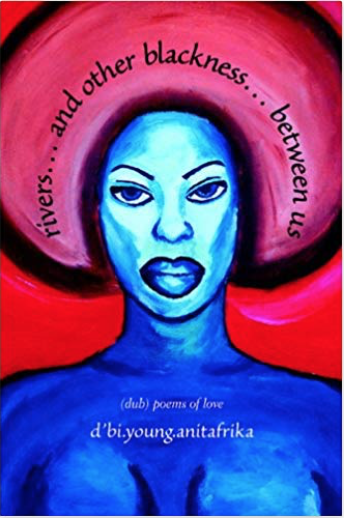
In the preface to her first collection, art on black, d’bi.young.anitafrika defines dub as follows: “dub is word. dub is sound. dub is powah. dub poetry is performance / poetry / politrix / roots / reggae” and identifies four elements of dub poetry-language, musicality, political content, and performance. Since then, anitafrika has elaborated three additional elements-urgency, sacredness, and integrity-which infuse and inform her own practice of dub. These additional elements signal the arrival of the visionary poetics found in rivers… and other blackness… between us, a book that confronts systemic racism in Toronto, the ongoing global effects of colonialism and imperialism, and pursues a vision of a just future. In “young black,” anitafrika repeats the incantation “you are brilliant and beautiful and / strong and rare” in a poem in which puns play alongside explicit commentary on local, national, and global politics:
because I am more than the roundness of my ass

the width of my tits

the thickness of my thighs

the depth of my hips

the glimmity-glammity hold him tight

all through the night

is not necessarily my numbah-one priority

. . .

we

walking through metal detectors in school

that refuse to detect the rape and pillage

recolonized by the great

harris-tocracy

we

experiencing

the military’s militarization

of high school and middle school education

police officers turned hall monitors.

Following in the dub tradition, anitafrika makes explicit her commitment to “revolushun.” And more than even a political revolution, it is a “revolushun” in poetic language and form. Throughout the book, anitafrika switches between Creole and official “Standard English,” and enacts dub’s unofficial, emphatic intervention into this official world and its language. For the most part, anitafrika opts for a direct treatment of her subject; her poems operate primarily in the realm of what performance scholar Rebecca Schneider calls “explosive literality.” At points, however, she ventures into more fragmentary and dramatic forms as in “when the love is not enough: the conversation i never had with billie holiday,” a mournful love song in two voices, a dialogue that reflects anitafrika’s skill as a playwright.

Overall, the poems in rivers embody anitafrika’s seven elements of dub. Some readers may resist these elements and balk at the polemical tone of the book as a whole, but I encourage readers to consider these elements, and the poems they produce, in the context of our contemporary moment, in the context of the city section of the morning newspaper, and to reflect how this poet, and others working in the dub tradition, refuse to hide behind a veil of obscurity, and resist oppression with words, insisting that these words can do something more than sit on a page.

While anitafrika’s poems read as the verbal weapons of a pacifist street-fighter, Motion’s new collection, 40 dayz, is an urban, funk anthem for the T.Dot-Toronto in 2008. These poems focus mainly on a series of vignettes about life in Toronto’s North End and are figured through a series of metaphors that at once embrace and reject, reflect and conceal their own trajectories. Unlike the straightforward, linear narratives of much of the popular spoken word of today, Motion’s poems-which several times reminded me of the work of New York slammer-turned-sound-poet, Tracie Morris-mostly avoid the didactic approach in favour of vivid, image-based, but still political, long lyrics. While there is restraint here, I appreciate the revelations as well, and the irrepressibility and emergence that, for me, bring life to these poems. For example, “woman,” a poem that reveals the torment of watching a friend undergo cancer treatment, lays bare the painful ritual of hospital visits:


when we’d say goodbye

it was just till tomorrow

another day of chat chatting

bawl bawling

another 24 hour crisis

a next episode of girl I got your back.

Similarly, and this is a passage that particularly made me think of Morris, ” the calling” writes the heat of a summer night in Toronto along with a set of contradictions for which the poet has no solution:

buckles bones rip knots from limbs

lost and seeking

hearing home in a clearing

of dust

dancers    jeaned     skirted

sneakered and sandalled

sweaty and silent   speak

and cry as bodies wild out

wrenching against chains

leaping from ship boards

beating down kicking.

The only question marks on my copy of this book occur beside images that were, a few times, abstract to the point of disguise, and I couldn’t figure out what the poet was hiding, or why she was hiding it. However, taken as a whole, this book brings the reader on a sometimes boisterous, sometimes contemplative bus ride across an urban wilderness, through Toronto, to Kingston’s jails, and to South Africa. 40 dayz is a New Testament of Toronto poetry.

Finally, there is one similarity between these books that I want to draw attention to here. Both poets give significant weight to “womb” language and imagery, and both draw a generative power from what anitafrika calls a “wombanist” approach to poetry and politics. For some, this “wombanism” may cause a gender-essentialist alarm to sound, and certainly this is my first reaction. My Third-Waver feminist politics tell me that the danger of this “wombanism” is that it risks universalizing women via biology. But I wonder, too, if, as Motion’s section title “transformashun” implies, these books mark a shift both in contemporary poetics and politics. Is it possible that we are in a post-anti-essentialist moment, and that these collections respond to the anxieties of dealing with the materiality of gender, especially the ways that these anxieties manifest in white feminism? This is a question that these collections refuse to answer, but I hope that it is one that others will ask too.

Posted in Press, Word | Comments Off on NEW BOOKS BY D’BI YOUNG & MOTION – CAN LIT REVIEW